

 EN
 AR
 BG
 HR
 CS
 NL
 FR
 DE
 HI
 IT
 JA
 KO
 PT
 RO
 RU
 ES
 SV
 TL
 ID
 LT
 SR
 SK
 SL
 UK
 VI
 SQ
 ET
 GL
 HU
 TR
 AF
 GA
 BE
 MK
 MN
 NE
 KK
 UZ
 KY
 XH
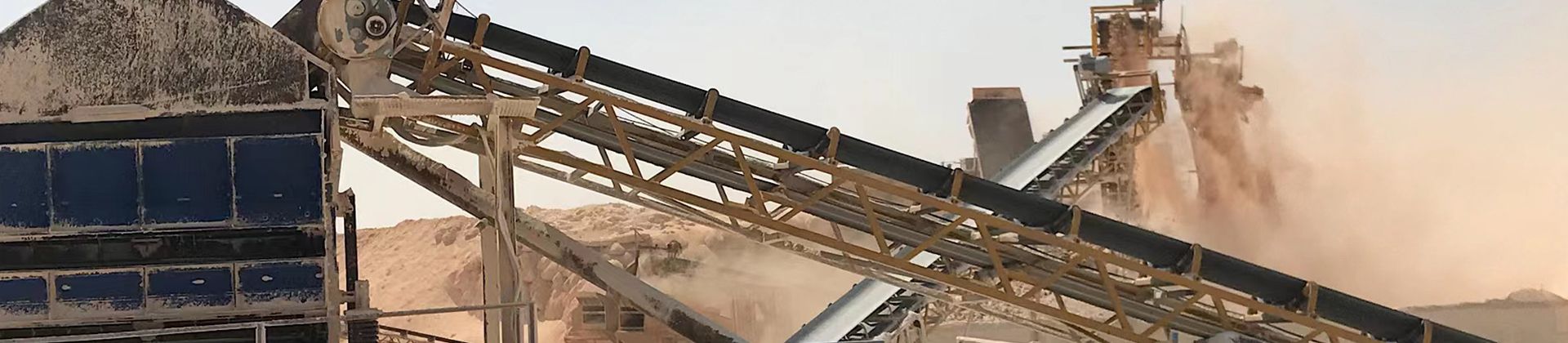
Quarry Spare Parts Are Not a Purchasing Problem — They Are a Cost-per-Ton Problem
In a quarry or mining operation, quarry spare parts are bought as a line item but paid for as a production variable. Two identical-looking parts at different prices can differ by a factor of two in cost per ton once installation labour, change-out downtime and tonnes delivered are counted. The discipline that controls this is not sharper negotiation — it is specifying against measured duty, measuring tonnes per component, and holding the parts whose absence would stop the plant for longer than their lead time.
KILOMEGA supplies conveyor, crushing, transmission and screening components to quarry, cement, mining and port operations from a Ningbo engineering and manufacturing base, with an overseas service subsidiary, BEDROCK, operating from Al Hasa in Saudi Arabia. What follows is the specification logic we apply when a customer asks which part to buy.
Why the Cheapest Quote Is Rarely the Cheapest Part
A jaw plate, a conveyor belt and a set of idlers sit in the same budget column but behave nothing alike. Each has a different failure mode, a different replacement lead time, and a different production consequence when it fails. Collapsing them into one price comparison is how plants save 15 percent on a component and lose 40 hours of production to it a quarter later.
The useful mental model for quarry spare parts is a cost centre with three outputs: availability, component life and maintenance labour. Every parts decision moves all three at once. A belt specified one grade higher costs more per metre and may cut splice failures; an unbranded crusher liner may arrive faster and change the chamber profile enough to raise power draw and reduce output. Neither outcome appears on the purchase order.
That is why procurement measured on unit price and procurement measured on availability produce different suppliers, different stock policies and different maintenance budgets — from the same plant, in the same year.
The Four Wear Zones in a Quarry Circuit
Every crushing and conveying circuit consumes quarry spare parts in four zones. Mapping spend against them usually reveals one zone that is over-serviced and one that is quietly neglected. The table below is the framework we use in a specification review.
Conveyor belts and components
Belts, splices, idlers, pulleys, lagging and skirt rubber form the highest-frequency wear zone. The dominant failure drivers are rarely abrasion resistance. They are impact loading at the transfer point, misalignment caused by worn idlers, and splice quality. A belt that fails at the splice after six months is a splicing and tensioning problem, and no upgrade in cover grade corrects it.
Fire resistance needs a separate decision in coal, cement and enclosed structures, where a standard abrasion-resistant belt is simply the wrong specification regardless of price.
Crusher wear parts
Jaw plates, cone liners, blow bars and hammers set the economics of the whole plant, because they control both wear cost and the product curve. Two liners at the same price per kilogram are not equivalent: manganese grade, hardness profile and cavity design decide how many tonnes each set delivers and whether the closed-side setting holds as the liner wears.
Transmission and drive components
Motors, gearboxes, V-belts, pulleys, sprockets, chains and couplings are the quiet zone until they fail. A drive selected on nominal load with no service factor margin fails at the first surge or choked transfer point, and V-belt sets replaced one belt at a time instead of as a matched set remain a reliable source of repeated failure and vibration.
Screening media
Screen mesh and panels wear faster than most maintenance budgets assume, and worn media does not fail loudly. It degrades separation efficiency, pushes oversize into the product pile and loads the crusher circuit with recirculating material — which presents as a throughput problem and is usually diagnosed late.
Where Downtime Actually Comes From
Conveyor-related stoppages account for the largest share of stoppage events: belt damage, splice failure, seized rollers, misalignment, spillage. They also usually involve the shortest individual repairs. Crusher stoppages are fewer but far longer, because liner and jaw replacement needs confined-space access, lifting gear and skilled labour. Drive and transmission failures are rare, yet one motor or pulley can idle an entire line while a replacement is sourced.
The two categories need opposite strategies. High-frequency, short-duration events are compressed with condition monitoring, correct specification and stocked consumables on site. Low-frequency, long-consequence events are eliminated by holding critical spares and validating the replacement procedure before it is needed.
Plants that track only total downtime hours tend to over-invest in the first category and under-invest in the second, because belt stoppages dominate the count while crusher and drive failures dominate the cost. Recording downtime by cause, duration and production loss separately turns an anecdote into a budget argument.
Cost per Ton: The Worked Comparison
Cost per ton is total cost of ownership divided by tonnes delivered. Total cost includes purchase price, freight and duty, installation labour, production lost during change-out, and any quality-driven rework.
The figures are a modelled example typical of a mid-size aggregate plant, not a customer result — the labour and downtime rates must come from the operator's own cost accounting, or the model is marketing with a decimal point.
Two cautions follow. First, a long-life part that arrives fourteen weeks after failure carries an unlimited cost in the quarter it is needed, so lead time belongs inside the calculation, not beside it. Second, the comparison only works if tonnes are actually recorded; a plant that does not weigh production cannot price a wear part.
Six Questions Before You Place a Parts Order
These are the questions our technical team asks before quoting quarry spare parts, and the ones a buyer should ask a supplier.
What is the actual duty, measured rather than assumed? Throughput, lump size, drop height, incline, ambient temperature, moisture and hours per day. A belt ordered against "abrasive stone" is a guess; a belt ordered against a measured duty is a specification.
What is the failure history at this position? Which component failed, after how many tonnes, and how long did the repair take. Two failures at the same position within a year is a specification error, not bad luck.
What is the true lead time, in writing? Not the catalogue lead time — the actual time from confirmation to arrival at site, including the customs step on an international shipment.
What does it cost per ton, not per unit? If the supplier cannot discuss tonnes per set, the comparison has not started.
What happens at 2 a.m. on a Sunday? Who answers, in which time zone, and how quickly can a replacement reach site. This question separates a trading company from a supply partner.
Who records the outcome? A part installed without a recorded service life cannot be evaluated, and the next order repeats the same decision on the same assumptions.
Critical Spares: What Belongs on Site
A critical spares list for quarry spare parts is not a full inventory. It is a short, ranked list of parts whose absence would stop production for longer than the lead time allows.
Each part is scored on lead time, production consequence and failure predictability. Parts with long lead times and severe consequences are held on site regardless of price; wear-driven parts with short lead times belong on a scheduled replacement plan instead. For most single-line quarry plants a workable structure is crusher liners and jaws sized to one change-out, one spare drive motor for the critical conveyor, belt repair and splice material, and a rolling consignment of idlers and rollers.
The list has a second effect that is easy to miss: it forces a written conversation about lead times with every supplier, including the ones who would rather leave the subject alone. Review it quarterly against actual consumption, and remove any line that has sat untouched for a year — stock that never turns is capital that never works.
How KILOMEGA Supports Quarry and Mining Operations
KILOMEGA is a material handling equipment and parts supplier based in Ningbo, China, serving quarry, crusher, cement, concrete batching, chemical, steel, port and bulk material handling operations in export markets. Our business is built on four connected categories rather than a single product line: conveying equipment, transmission equipment, crushing equipment and screening equipment.
Four categories, one specification. Conveyor belts, idlers, pulleys and lagging sit alongside jaw plates, cone liners, hammers, motors, gearboxes, V-belts, sprockets, chains and screen media. That breadth matters in a quarry, because a stopped line is rarely caused by a single system — a worn screen sends oversize back into the crusher, and a choked transfer point overloads the drive.
Manufacturing depth behind the parts. Our supply chain covers a Ningbo engineering and manufacturing base, which is what allows non-standard dimensions and OEM-equivalent wear parts to be produced against a drawing rather than pulled from a catalogue.
Batch testing, reported. Hardness, tensile and adhesion results are recorded per batch and available for review. A supplier who tests every batch can produce documents; a supplier who buys on certificate cannot.
Regional service through BEDROCK. Our overseas subsidiary BEDROCK operates from Al Hasa in Saudi Arabia, delivering conveyor belt splicing, on-site technical support and regional stock for Middle East customers. That is the practical answer to the lead-time question: manufacturing volume at the factory, response capability inside the market.
Documented outcomes. Tonnes per liner set, splice life and component service life are recorded and reviewed with the customer, so the next specification decision rests on data from the last one.
📱 WhatsApp:+966 56 171 7029
✉️ 邮箱: [email protected]
🌐 网站: www.kilomega.sa
